You have a printer, a client at the door and no time to design anything. Printable free dog grooming forms can run your desk, as long as you know which six forms you need and what each one has to hold.
A free blank form is a fair starting point, but it was written for nobody in particular. Below are the six forms a grooming desk uses, what each one must hold, and a quick test to run on whatever you download. The wording on any form is general information, not legal advice, so have it read by someone qualified in your state.
1. Intake and pet profile: the form every new client fills in once
The intake form tells you who owns the dog, who else may collect it and what you need to know before the clippers start. Print it for the first visit only, and keep it in the dog's file.
Check that yours has room for the owner, a second contact, an emergency contact and the name of anyone who may pick the dog up. It should ask for the vet, any health conditions and medicines, how the dog behaves with strangers and dryers, the coat type, and products to avoid. Add a signature line and a date.
The reason is simple. The U.S. Bureau of Labor Statistics says groomers identify problems that may require veterinary attention. You can only spot a change if you wrote down the baseline.
A form that stops at name and phone gives you none of that. Hold your free download up to the list above and write in any line it lacks.
2. Release and consent: one short form per risky situation
A release form covers one specific situation that a client has accepted. Matted coats, senior dogs, nervous dogs, photo permission and fleas found during the groom are the five that come up most.
Each one needs the dog's name, the date, what you saw or were told, what you will do, your own terms and two signatures. Keep terms short and in your own words, because they have to match what your salon really does.
Free release forms are the hardest to borrow. Wording that suits a salon in another state, or another way of working, can promise things you do not do. Treat a download as a layout, then write the terms yourself.
3. Vaccination record: dates copied from the papers
A vaccination record lists each vaccine, the date it was given and the date it runs out, copied from the paperwork the owner brings. Your salon decides what it asks for. The record only keeps track of it.
The Centers for Disease Control and Prevention (CDC) says that pet owners can lower their risk by keeping pets up to date on rabies vaccines. That is a good reason to note the date, though the rules about which vaccines are required, and how often, differ by place. Write what is on the papers and nothing more.
Give each vaccine its own row and add a column for "seen on" so you know when you last checked the paper. Six rows is plenty for one dog.
4. Drop-off check-in sheet: the record that settles arguments
A check-in sheet records what the dog looked like when it came in, who is collecting it and what the price is today. Print one per visit.
The sheet should hold today's phone number, the pickup time, anyone else collecting, the service and price, and anything left with the dog. A numbered list of body areas also belongs on it, where you note skin, ears, nails and coat. A simple outline of a dog, front and back, lets you mark where a mat or a red spot is. Initials from the owner and from your staff go at the bottom.
When a client says "that scratch was not there this morning", the sheet answers it in ten seconds. It feeds your pickup note as well, since you already wrote down what you saw at the start.
5. Service agreement and salon policies: what you do, in writing
The service agreement lists the rules every client agrees to, such as late arrivals, cancellations, payment, pickup times and what happens with matted coats. It is signed once and read again when a policy changes.
Aim for about ten topics, each in two or three short sentences. A policy that is too long to say out loud is too long to enforce. Print the same wording on the wall and in the agreement so clients see one version.
If a free agreement you found promises a cancellation window or a fee that you do not apply, strike it out. Do this before it goes in a client's hand. A rule you do not follow is worse than no rule.
6. Where the signed pages live: a file you can find in a minute
Forms hold names, phone numbers, addresses and health notes, so how you store them matters. The Federal Trade Commission's guide for business tells owners to keep only what they need, protect what they keep and properly dispose of what they no longer need.
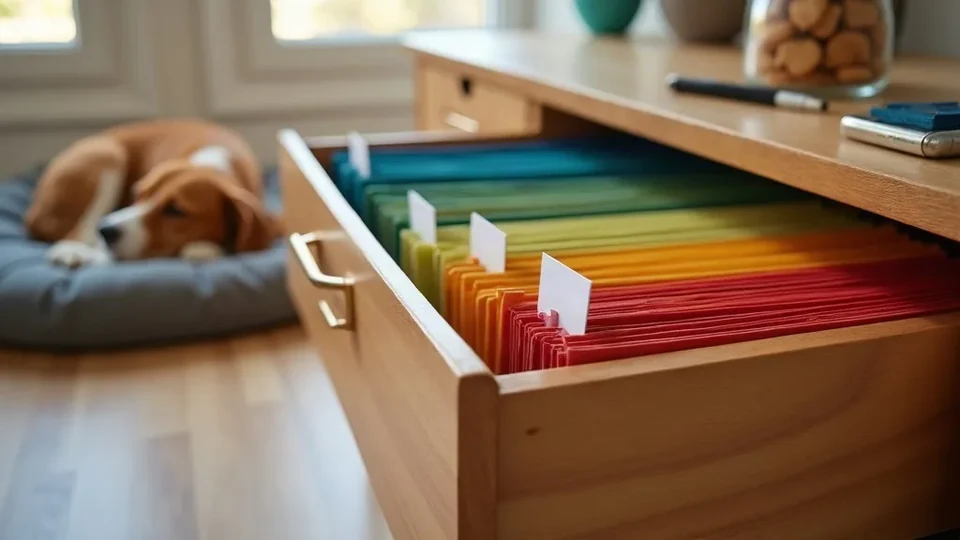
For a one-person salon, that means a lockable drawer or box, one folder per dog, and a shredder for forms of clients who left long ago. I found no single source that sets how long a groomer must keep client forms. The rule can differ by state, so ask your state's licensing office or your insurer for the period that applies to you. Do not photograph forms with your personal phone and leave the pictures in your camera roll.
Here is a worked example, as arithmetic from stated assumptions and not as a measurement. Say you see 20 new dogs and 60 repeat visits in a month. A new dog gets a 3-page intake, a 2-page agreement and a 2-sided check-in, which is 7 sides. Each repeat visit gets one 2-sided check-in. That is 20 × 7 + 60 × 2 = 260 sides of paper a month. A drawer with one labelled folder per dog is not optional.
| Example month | Visits | Sides per visit | Sides of paper |
|---|---|---|---|
| New dogs (intake, agreement, check-in) | 20 | 7 | 140 |
| Repeat visits (check-in only) | 60 | 2 | 120 |
| Total | 80 | Mixed | 260 |
How to choose free printable dog grooming forms
Before you print twenty copies of anything, hold it up to this table. A free blank form is fine when it passes the test in the second column. A matching set earns its price when you keep patching.
| Form | A free blank is enough when | You keep patching when |
|---|---|---|
| Intake and pet profile | It has owner, second contact, vet, health and behavior lines | You add the same missing lines to every copy |
| Release and consent | You wrote the terms yourself in your own words | Terms came from another salon in another place |
| Vaccination record | It has a row per vaccine with the date from the papers | You redraw columns by hand each time |
| Check-in sheet | It has a body outline and a pickup time | You scribble condition notes on the back |
| Service agreement | It lists only policies you really apply | It promises fees you do not charge |
| Storage | You have a drawer with a lock | Forms live in piles on the counter |
A form is only useful if the next person to open the folder can read it.
Our Salon Front Desk Kit pulls seven of these desk products into one bundle for $16.99, where buying them separately would cost $31.93. It holds the intake and pet profile, the release, matting and consent forms, the service agreement and salon policies and the client record card. The kit holds the drop-off check-in sheet, the appointment book and the report card.
One free page can be enough when you need one form and already know your fields. What our kit adds is a worked example, filled in for an invented salon, ahead of each blank form. It also has fields you can type into before printing and the same pages in US Letter and A4. It is built for a salon desk, run alone or with staff. The intake has lines for a cat and the check-in sheet has a cat outline. Nothing in the kit is made for a van, so mobile groomers should look at our Mobile Groomer Kit ($21.99) instead.
When free forms are the better choice
If you only need one form, take the free one. A single intake sheet that you fill with your own fields costs you nothing and you do not need a set for that.
A set is the wrong answer if you work with a digital booking system that already collects client details and signatures on screen. Printable forms only help a desk that runs on paper. Our forms also leave your terms blank on purpose. They give you the structure and you supply the rules, so they do not replace advice from someone who knows your state's law.
Printing your first forms today
Open the form you use most, check it against the fields in section 1 or 4, and add the missing lines by hand. Then print twenty copies and put them where the next new client will fill them in.
For a matching set instead of a patched one, our Salon Front Desk Kit is the bundle to look at.
Frequently asked questions
Conclusion
Start with the form you reach for most often, which is usually the intake. Check it against the fields in this list, fix what is missing by hand, and print twenty copies. Add the check-in sheet next, then the release forms for matting and seniors. Keep every signed page in one folder that you can open in a minute. If free forms stop saving you time because you keep patching them, that is the moment to look at a matching set.
Sources
- U.S. Bureau of Labor Statistics, Animal Care and Service Workers, Occupational Outlook Handbook (2026). Last checked October 7, 2026.
- Centers for Disease Control and Prevention, Rabies Prevention and Control. Last checked October 7, 2026.
- Federal Trade Commission, Protecting Personal Information: A Guide for Business (n.d.). Last checked October 7, 2026.