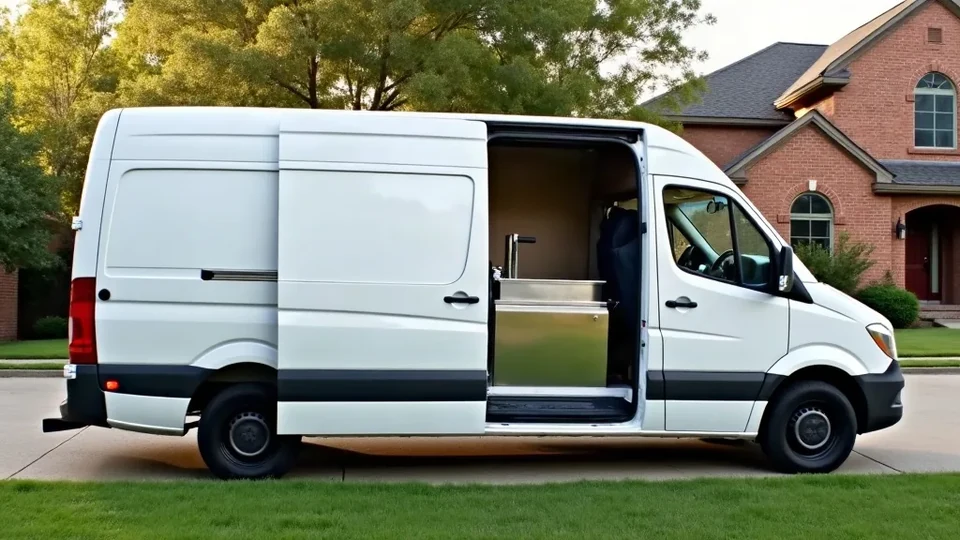
A van changes what a price list has to say. A mobile dog grooming price list needs the usual size and coat lines plus a travel ring fee, a minimum visit and a price for van time.
A salon list answers one question: what does this dog cost? A van list has to answer a second one: what does it cost to get to this dog? The seven lines below are the ones a mobile groomer adds, in the order a client reads them. The numbers are arithmetic from assumptions stated in each line, so swap in your own.
1. Size and coat bands, priced by the minutes in the van
Start with the lines every list has: a few weight bands, a coat condition note, and a base groom. In a van, price each band from the time it holds the van, not from a salon habit. The van is booked for the whole visit, so setup and pack-up count.
Coat type has no standard tier to copy, and no source I found gives one. Measure instead. A double coat that takes 30 minutes longer to dry is 30 more van minutes, whatever the breed is called.
Take an example van with 25 minutes of setup and pack-up per stop. Its target is $55 for each hour the van is working. The groom itself takes 60, 90 and 120 minutes for small, medium and large dogs in this example. That gives 85, 115 and 145 van minutes. After rounding, the prices are $78, $105 and $133 (85 x 55 / 60 = 77.92, and so on).
| Band (example) | Groom minutes | Van minutes | Price at $55 per van hour |
|---|---|---|---|
| Small | 60 | 85 | $78 |
| Medium | 90 | 115 | $105 |
| Large | 120 | 145 | $133 |
2. A travel ring fee for each distance band
A ring is a band of distance from where the van starts its day. Clients in the first ring pay the lowest travel fee, and the fee steps up as the drive gets longer. Three rings are enough for most areas, and a client can read them at a glance. A single flat fee is simpler to print. Below, a flat $24 would charge Ring A $12 above its fee of $12 and leave Ring C $16 below its fee of $40.
Price each ring from its round-trip cost. The Internal Revenue Service (IRS) standard mileage rate is 76 cents per business mile from July 1 to December 31, 2026. It is 72.5 cents from January 1 to June 30. This rate is for operating a car, so treat it as a floor. Replace it with your van's real cost per mile once you know it. For your own time on the road, this example uses $25 an hour. For comparison, the Bureau of Labor Statistics lists median pay for animal care and service workers at $17.08 per hour in 2025. An owner who also carries the van's risk should price above a wage.
For Ring B, 14 miles x $0.76 is $10.64 and 30 minutes at $25 an hour is $12.50. The two add up to $23.14. Round it up to $24 and print it on the list.
3. A minimum visit so a short groom never loses money
A minimum visit is the lowest total a client pays for one stop, travel included. Without it, a nail trim in the farthest ring costs you more than it brings in.
Set it from the smallest groom you take plus the ring fee. In the example, the smallest groom is $78 and the first ring fee is $12, so the floor is $90. Say "minimum visit $90" in one line on the list, and apply it to every ring. A client in Ring C who books only nails will pay $90 or more, which still leaves the $40 trip covered.
4. A second-dog price at the same address
Two dogs at one stop share one setup, one parking spot and one trip. The second dog should cost less, and the list should say how much less.
The second small dog in the example skips the 25 setup minutes, so it holds the van for 60 minutes. That is 60 x 55 / 60, or $55, against $78 for the first. Charge the travel ring fee once, not twice. Put the discount as a dollar amount on the line, because "10% off" invites a negotiation.
5. Add-ons priced by the ten minutes
De-matting, a second shampoo and a thick-coat blow-out take van time. Price them by the minute rather than by a flat guess. Teeth brushing, de-shedding and flea baths work the same way. No source gives a standard time for them, so time each one in your own van first.
At $55 per van hour, ten minutes costs $9.17. Round to $9 and write "de-matting: $9 per 10 minutes, quoted before we start". A dog that needs 30 minutes of de-matting then adds $27 to the visit. Quote it at the door, before the first brush stroke, and write the quote on the day sheet.
6. A not-home and gate line
A trip that ends at a locked gate has still used fuel and an hour. The list needs one sentence for it.
Charge at least the ring fee, which is $24 for Ring B in the example. Say so in the booking confirmation as well as on the list. Add a line for blocked access, such as a gate code that was never sent. The trip happened either way, and the line shows the client that you know it.
7. The days, areas and payment terms in one line
Mobile clients also want to know when you come to their street. Write "Tuesdays and Thursdays, Ring A and B only" or similar. Add how you take payment and how far ahead you book.
Keep this line short. It tells a client in Ring C why the first free slot is two weeks away, and it keeps your route tight. The payment terms belong on the same line, because a client at the door should never have to ask. Put the same list on your website and on a card you hand over at the door, with the date on each copy.
How to choose lines for your mobile dog grooming price list
Not every van needs all seven lines on day one. Use the table to decide what goes on the first printed list.
| If you... | Start with these lines |
|---|---|
| Work one town and rarely drive over 10 miles | 1, 3, 5 |
| Serve a spread-out area | 1, 2, 3, 6 |
| Book many two-dog households | 1, 2, 4 |
| Take a lot of matted coats | 1, 5 |
| Have a waiting list | 1, 2, 3, 7 |
Add the others when you see the problem they solve. A list that fits on one page gets read, and a list that needs a second page gets skipped.
A free printable list can be enough when it has blank lines you fill in yourself. Our Mobile Groomer Kit ($21.99) adds a Hang-up Price List with a worked example page and fillable boxes. It has menus for dogs in three, four or five sizes, add-ons and cats, in US Letter and A4. The kit also has a Mobile Visit Cost workbook (.xlsx) that prices one trip from your own van rates. A day sheet, appointment book, release form and local handout come with it. Every price is yours to type, since nothing is pre-priced. It fits a van, and a home studio or salon can use the menus and the workbook too, solo or with staff. If you only book a handful of nearby visits and never drive more than a few miles, a handwritten list on your own paper is enough. The kit adds nothing you need then.
A price list earns its keep on the day you want to say no.
A last check before you print: read every line aloud as if a client were standing at the van. If you would need to explain a line, rewrite the line. Date the page, and revise it when your fuel price or the mileage rate changes.
Frequently asked questions
What does mobile dog grooming include?
Only what your list says it includes. Write the groom (bath, dry, cut, nails) on the base line, then name the extras that cost more time, such as de-matting, and the travel ring fee as separate lines so a client can see what each one pays for.
Is mobile grooming more expensive?
It usually has to be, because the van adds a trip that a salon does not have: drive time, fuel, setup and pack-up. The worked example below puts that trip at about $11 to $39 depending on distance, and the price list shows it as its own line.
Conclusion
Start with the line you are most likely to skip, the travel ring. Work out the three round-trip costs for your own area, round each up, and print them on the list before you take the next booking. Add the minimum visit and the van-time rate once the rings feel normal to say out loud. Review the whole list when the mileage rate or your fuel price moves.
Sources
- U.S. Internal Revenue Service, Standard mileage rates (2026). Last checked October 7, 2026.
- U.S. Bureau of Labor Statistics, Occupational Outlook Handbook: Animal Care and Service Workers (2025). Last checked October 7, 2026.