Going mobile means you build the salon on wheels yourself. Here is how to start a mobile dog grooming business. Choose the vehicle, fit it out and check where you may park and work. Set a route area, insure the van and the dogs, add up the costs and book the first week.
A salon starts with a lease. Mobile work starts with a vehicle, and nearly every later choice follows from it. The seven steps below run in the order that saves rework. Dollar figures marked as examples are arithmetic from invented assumptions.
Step 1: Choose the van, trailer or in-home model
The vehicle sets your costs, your parking and the size of the dog you can take. Pick it first.
Vans and box trucks carry a built-in tub, a table and its own water, and they cost the most. A trailer needs a tow vehicle you already own. In-home grooming means you visit and use the client's tub or your own portable table. There is no vehicle fit-out at all, but each stop has a bigger setup. Decide how large a dog you plan to groom and how many stops a day you want, then match the vehicle to that.
Prices vary widely, so get quotes before you plan around any figure. The Academy of Pet Careers, a grooming school, reports (July 2026) used equipped vans at about $45,000 to $100,000 and equipped trailers at about $18,000 to $40,000. It also lists two new Sprinter-based builds at $129,528 and $137,487 in total. The same page puts an overall range at $12,000 to $140,000 or more. It gives no single price for a do-it-yourself conversion of a van you already own. Treat that route as a quote you collect yourself. These are one school's figures.
Step 2: Fit out the van for one dog at a time
A fit-out is the work that turns an empty van into a grooming room. The list is short and every item has a failure mode.
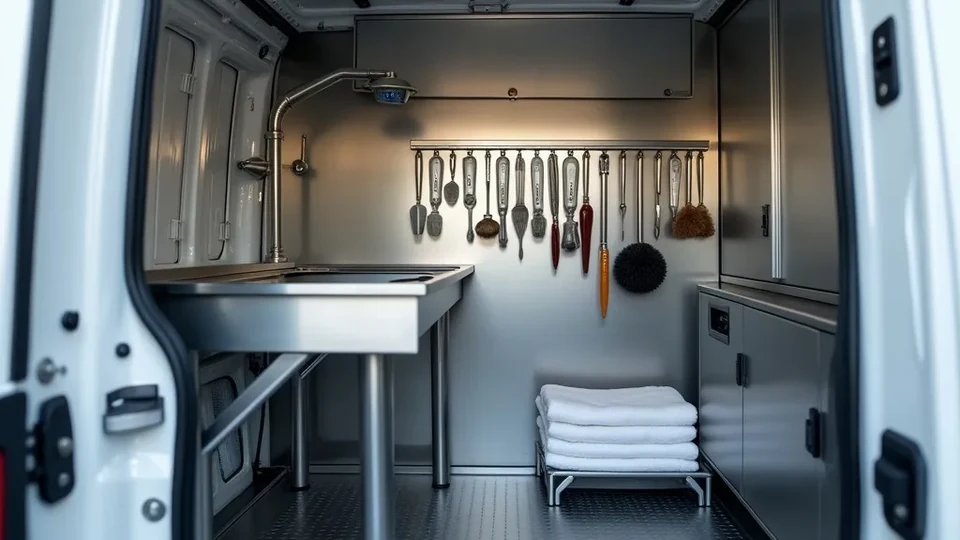
You need a table with an arm, a tub or a wash station, hot water and a way to power dryers. You also need heat and cooling, ventilation, non-slip flooring and a place for clippers, blades and towels. Decide how you will power the dryers, with a generator or a shore power hookup, before you design the cabinets. Water comes next. Tank size sets how many dogs you can bathe before you refill. Build the fit-out around the biggest dog from Step 1, then check that a second person could walk around the table. The same school lists a water tank and heating system at $200 to $1,000 and a generator or other power source at $500 to $2,000. It gives no tank sizes. Ask the builder how many baths one tank covers for the coats you plan to groom.
Step 3: Check where you may park and work
Parking and zoning are local, and they can end a van business before the first groom. Check them before you buy.
The U.S. Small Business Administration (SBA) says that the licenses and permits you need from the state, county or city depend on your business activities and location. It adds that zoning ordinances can apply even to home-based businesses. Ask your city or county office three questions. Do I need a business license? Can I park on a residential street for several hours? Where may the wash water go? Ask about homeowner association rules too, since your clients live under them.
Wash water needs its own plan. A stormwater program in Marin County, California, says wash water should never go to the street, gutter, parking lot or storm drain. Groomers should drain it to the sewer or collect it in a holding tank or drum for later sewer disposal. The program adds that a one-time discharge permit may be required, so check your own area's rules. This is one county's guidance, and rules differ elsewhere.
| Question to ask | Who to ask |
|---|---|
| Business license for a mobile service | City or county clerk |
| Parking for several hours at a client's home | City parking office, client's homeowner association |
| Where wash water may drain | County environmental or water office |
| Home-based storage of the van | Zoning office |
Step 4: Draw your route area
A route area is the set of streets you will drive to, drawn so a day of stops stays tight. Start with the drive time you are willing to lose.
Pick a base address and decide the longest drive you accept in minutes. Then split the area into three rings by distance, as a mobile price list would. The Internal Revenue Service (IRS) standard mileage rate is 76 cents per business mile from July 1 to December 31, 2026, and it makes a useful benchmark for what each mile costs. In the example, a 24-mile round trip costs $18.24 in miles alone (24 x 0.76), before the hour it takes. Cluster bookings by area on set days, such as east on Tuesdays and west on Thursdays.
Step 5: Insure the van and the dogs in your care
Insurance for a van business covers two things. These are the vehicle on the road and the dog while it is in your hands. Get quotes for both.
The SBA lists the common types: general liability, professional liability, commercial property, home-based business insurance and a business owner's policy. Its page does not cover vehicles. Ask a broker directly about coverage for a business van and about the dog in your care. Ask whether the van's contents and equipment are included too. Get the quote in writing before you buy the vehicle. If you cannot insure the vehicle at a price you can pay, it is the wrong vehicle.
Step 6: Add up the start-up costs
Start-up costs are two lists. The SBA calls them one-time expenses and monthly expenses: major equipment, permits and licenses are one-time, and recurring bills are monthly. It advises counting at least one year of monthly expenses.
Here is an example with invented prices. One-time: used van $22,000, fit-out $9,500, tools and supplies $1,800, permits and registration $600, cards and a simple website $400. That is $34,300. Monthly: insurance $320, phone and booking software $60, supplies $250 and driving at the IRS benchmark for 800 miles, which is $608 (800 x 0.76). That is $1,238 a month, or $14,856 over twelve months. Together the opening budget in this example is $49,156. Your van, quotes and permits will change every line.
| Step | What to do | What to watch for |
|---|---|---|
| 1 | Pick van, trailer or in-home | Biggest dog you take |
| 2 | Fit out table, tub, power, water | Dryer power and tank size |
| 3 | Ask city and county | Parking hours, wash water |
| 4 | Draw three rings | Drive minutes, not just miles |
| 5 | Get written quotes | Vehicle and dog coverage |
| 6 | Total one-time and monthly | Twelve months of bills |
| 7 | Book and time a first week | Real minutes per stop |
Step 7: Book and time your first week
The first week is a test of your numbers. Book it deliberately, with a few friendly clients, and write down every minute.
Fill four days with two or three stops each, in one ring if you can. Time arrival, setup, the groom, pack-up and the drive to the next stop. After the week you will know your real minutes per dog, which sets your price list. The Academy of Pet Careers says most owner-operators groom between 3 and 6 dogs a day, depending on coat type and drive time between stops. Use that as a rough check, not a target. Keep a mileage log from day one, and note any dog who needs a longer slot next time.
Our Mobile Groomer Kit holds a day sheet and a visit cost workbook that fit this first week.
A free printable log can be enough if you only need a place to write mileage. Our Mobile Groomer Kit costs $21.99 and adds a matched set. The Mobile Groomer Day Sheet has nine pages with a worked example of a van day, a van check list and stop notes. The Release, Matting and Consent forms are fillable with a filled example page, all in US Letter and A4. The kit fits a solo van groomer as well as a van with staff, and the Hang-up Price List has a cat section. Our Mobile Visit Cost workbook prices one trip, so it is the wrong choice if you never drive to clients.
Every mobile groomer runs a small business that happens to drive.
How to start a mobile dog grooming business on a small budget
A full van is not the only way in. Begin with in-home visits using a portable table and your own tools. Price them with a travel ring from the start. Move to a trailer or van once the calendar is full. Your costs stay near the supplies and mileage lines of Step 6, and you learn your real minutes per dog before you spend $9,500 on a fit-out. The catch is setup time: each stop starts from zero, so the first rings should stay small.
Before you commit, spend a day riding with a working mobile groomer if one will let you. One day tells you more about weather, parking and fatigue than a month of reading.
Frequently asked questions
How much does it cost to set up a mobile dog grooming business?
It depends on the van, so work it out in two parts: one-time costs (vehicle, fit-out, tools, permits) and monthly costs (insurance, fuel, supplies, software). In the worked example above the one-time total is $34,300 and the monthly total is $1,238, using invented example prices you should replace with real quotes.
What do I need to start a mobile dog grooming business?
A vehicle that fits a grooming table, water and power you control, the permits your city and state require, insurance quotes for the van and the dogs in your care, a price list with travel rings, and a booking system. The seven steps above put these in order.
What are the disadvantages of mobile pet grooming?
You carry the vehicle costs, you lose paid time to driving, weather and parking can cancel a day, and you groom one dog at a time. A salon spreads rent over many dogs, a van spreads a vehicle over fewer.
Conclusion
Mobile grooming is a chain of small decisions made in the right order. Settle the vehicle before the fit-out, the parking rules before the route, and the insurance quote before you pay for anything you cannot return. Then book one honest first week, drive it, time every stop and adjust the numbers before you open your calendar wider.
Sources
- U.S. Small Business Administration, Calculate your startup costs (2026). Last checked October 7, 2026.
- U.S. Small Business Administration, Apply for licenses and permits (2026). Last checked October 7, 2026.
- U.S. Small Business Administration, Get business insurance (2026). Last checked October 7, 2026.
- U.S. Internal Revenue Service, Standard mileage rates (2026). Last checked October 7, 2026.
- The Academy of Pet Careers, How to Start a Mobile Dog Grooming Business (2026). Last checked October 7, 2026.
- Marin County Stormwater Pollution Prevention Program, Mobile Pet Groomers (2023). Last checked October 7, 2026.