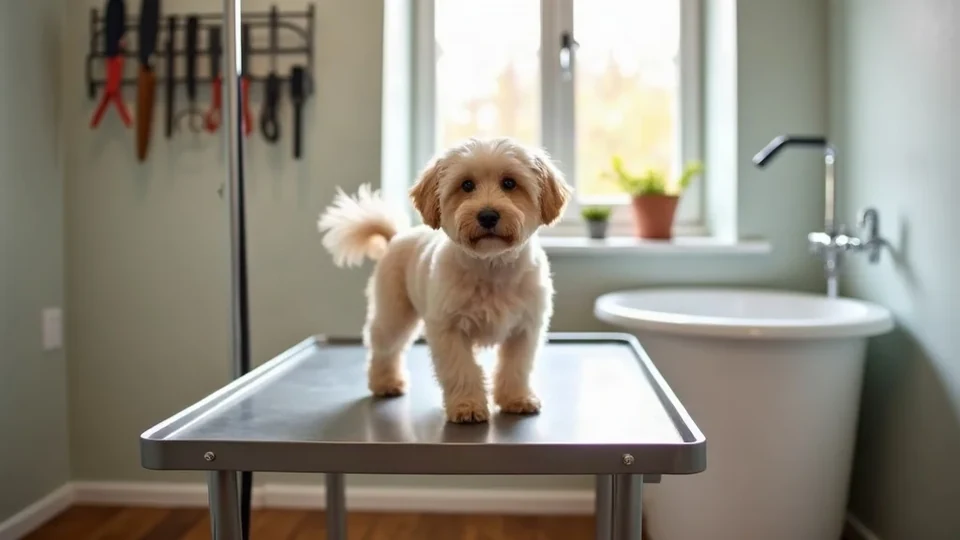
A blank plan is hard to start and a finished one is easy to copy from. A dog grooming business plan sample shows every section filled in for one invented salon. Each number traces back to the assumption behind it.
A dog grooming business plan sample for one invented salon
Maple Lane Grooming does not exist. It is one groomer in a rented shop, and every figure below is an example assumption you can swap for your own. The point is to see how the numbers connect from one section to the next.
The U.S. Small Business Administration (SBA) lists the usual sections of a traditional business plan. They are executive summary, company description, market analysis, organization and management, service or product line, marketing and sales, funding request and financial projections. SBA also says lenders and investors commonly ask for this kind of plan. It can run dozens of pages, while a lean plan can fit on one.
A solo groomer opening one shop can keep the words short. Spend your effort on the money pages.
| Item | Example assumption |
|---|---|
| Business | One groomer, one rented shop, no employees |
| Working days | 20 a month |
| Capacity | 4 grooms a day, so 80 a month |
| Average price | $78.25 per groom (worked out in step 1) |
| Cost per groom | $6.50 for shampoo, laundry, blade wear and card fees |
| Fixed costs | $2,024 a month (step 4) |
| Owner pay wanted | $3,000 a month, before income tax |
How the six steps fit together
| Step | What to write | What to watch for |
|---|---|---|
| 1. Business and services | What you groom, for whom, at what prices | Average price must come from your own mix of grooms |
| 2. Clients and marketing | Who lives nearby, who else grooms, how you reach the first clients | Use your own count of competitors, not a guess |
| 3. Start-up costs and funding | One-time costs, a cushion, where the money comes from | Count the cushion as part of what you need |
| 4. Monthly costs and break-even | Fixed costs, cost per groom, grooms needed | Compare break-even to the grooms you can physically do |
| 5. The first 12 months | Grooms, takings and what is left, by quarter | Ramp up slowly in the first quarter |
| 6. Risks and summary | Three risks with early signs, then one page that sums it up | Write the summary last |
Step 1: Describe the business and the services
Say in two sentences what you groom and where. The example is a one-groomer shop for dogs under 90 pounds, open Tuesday to Saturday. Then list the services with a price and the share of grooms each one will be.
| Service | Price | Share of grooms |
|---|---|---|
| Bath and tidy | $55 | 35% |
| Full groom | $85 | 50% |
| De-matting or large dog | $110 | 15% |
The average price is the number every later page depends on. Multiply each price by its share and add them up: 0.35 × $55 + 0.50 × $85 + 0.15 × $110 = $78.25. Do not use the middle price. If most of your grooms are the cheapest service, your average falls and so does everything below it.
A business plan is a list of numbers that each trace back to a decision you made.
Step 2: Show who the clients are and how the first ones find you
Write what you know about the area. In the example, the owner counted four other groomers within a 15-minute drive and found two of them booked three weeks out. That count is invented, but yours must be your own. Phone the shops, check their booking pages and write down what you find. Do the same for your clients. Note who lives near the shop, what kinds of dogs they have and which services they would book first. No public figure tells you how many of your neighbours want a groomer. Make a short list from your own look around the streets.
Then say how the first clients arrive. The owner budgets $150 a month for a flyer drop, a local listing and a sign. Rebooking is the cheapest marketing you have, so the plan also says every client leaves with the next date in the book.
Step 3: Add up start-up costs and the funding request
SBA suggests sorting start-up costs into one-time and monthly expenses. It says to count at least one year of monthly expenses, with five years ideal. A lender will want to see both lists. This is also the page where many owners stall, because the totals have to come from real quotes.
| One-time cost | Example |
|---|---|
| Tub, table, dryer, clippers, blades, shears | $6,800 |
| Shop fit-out and sign | $1,900 |
| Opening supplies | $600 |
| Permits and registration | $450 |
| Website and booking set-up | $350 |
| Opening marketing | $500 |
| One-time total | $10,600 |
| Cushion: three months of fixed costs (3 × $2,024) | $6,072 |
| Money needed | $16,672 |
The funding request follows from that total. The owner puts in $6,672 of its own cash and asks for a $10,000 loan. At an assumed 7 percent over 36 months, the payment is about $309 a month. That payment is already inside the fixed costs below.
Step 4: Work out monthly costs and the break-even point
Fixed costs are the bills you pay whether or not a dog comes in.
| Fixed cost | Per month |
|---|---|
| Rent | $1,100 |
| Utilities | $220 |
| Insurance | $95 |
| Marketing | $150 |
| Accounting and license renewals | $60 |
| Loan payment | $309 |
| Phone and internet | $90 |
| Total | $2,024 |
Break-even is the number of grooms where takings cover costs. Take the average price, subtract the $6.50 each groom costs, and divide the fixed costs by what is left. The sum is $2,024 ÷ ($78.25 − $6.50) = 28.2, so 29 grooms a month. Add the owner's $3,000 and the sum is ($2,024 + $3,000) ÷ $71.75 = 70.02, so 71 grooms, or 3.6 a day over 20 days.
Where does 4 grooms a day come from? Start with the time one groom takes. Zoetis Petcare says a bath and blow-dry for a Labrador lasts 1 to 2 hours. It says appointments with a haircut can take 1.5 to 4 hours. Take your own mix of services, give each its hours, and add the time for drying, cleaning the table and a break. Then divide the hours you will work in a day by the hours per groom. In the example, an eight-hour day at an average of two hours a groom gives four. That is arithmetic from example assumptions. Public sources do not give one number that fits every shop, so time your own first dogs.
Step 5: Forecast the first 12 months
Nobody is full on day one. Maple Lane ramps from 24 grooms in month one to 80 by month nine and holds there.
| Quarter | Grooms | Takings | Cost of grooms | Fixed costs | Left over |
|---|---|---|---|---|---|
| 1 | 96 | $7,512 | $624 | $6,072 | $816 |
| 2 | 168 | $13,146 | $1,092 | $6,072 | $5,982 |
| 3 | 226 | $17,685 | $1,469 | $6,072 | $10,144 |
| 4 | 240 | $18,780 | $1,560 | $6,072 | $11,148 |
| Year | 730 | $57,123 | $4,745 | $24,288 | $28,090 |
Figures are rounded to whole dollars. Left over is what remains before the owner's pay, income tax and self-employment tax. The Internal Revenue Service (IRS) puts the self-employment tax rate at 15.3 percent of net earnings. So the plan should say how much of the left-over money gets set aside for it.
Step 6: Add risks and plan B, then write the summary
Pick three risks and give each an early sign you can see and a plan B you can act on.
| Risk | Early sign | Plan B |
|---|---|---|
| Slow start | Fewer than 32 grooms in month two | Cut marketing to the free channels and delay the owner draw |
| Owner out sick | Two cancelled days in a month | Keep a cancellation line on the booking page and a one-week reserve |
| Rent rise at renewal | Landlord notice | Raise the average price by $2 per groom; that covers about $140 a month at 70 grooms |
Write the summary last, because it repeats the numbers. For Maple Lane it reads: "Maple Lane Grooming is a one-groomer dog shop. It needs $16,672 to open, covered by $6,672 of the owner's cash and a $10,000 loan. It breaks even at 29 grooms a month and pays its owner $3,000 at 71. Year one is planned at 730 grooms and $57,123 in takings."
Free forms or our template: what you get for $11.99
Free plan forms can be enough when your lender only wants a few pages or you already know how to lay out the numbers. Our Dog Grooming Business Plan Template costs $11.99 and comes in US Letter and A4. It adds a worked example salon on every even page from 4 to 30, beside your own page for each of eleven parts. You type into fields on 15 pages, and the business name is entered once for all of them. It asks whether you run a salon, a van or a home studio, and has van and home lines in the operations part. If you want a calculating workbook, or your lender has its own form, skip it.
When a filled-in sample will not be enough
A sample cannot do your arithmetic. Our template is a fillable PDF with no calculated fields, so you work each formula by hand in lettered boxes. Choose it when you want a worked example beside each of your own pages and like to see every sum. If you want a workbook that adds the totals for you, a spreadsheet is the better tool. And if your lender gives you its own form, fill that in and use this sample only to check your numbers.
Frequently asked questions
How profitable is a dog grooming business?
It depends on three numbers you control: your average price, the grooms you complete in a day and your fixed costs. In the invented salon above, year one leaves about $28,090 after supplies and fixed costs, before the owner's pay, income tax and self-employment tax. Your own result will differ, so work out your break-even first.
Conclusion
A plan for a one-groomer salon comes down to six pages of honest numbers. Fix your prices and count the grooms you can really do in a day. Add up what opening costs, then find the number of grooms where the shop stops losing money. Write the summary once those numbers hold still. Then put the plan away and check it against real takings at month one, three, six and twelve.
Sources
- U.S. Small Business Administration, Write your business plan (2026). Last checked October 7, 2026.
- U.S. Small Business Administration, Calculate your startup costs (2026). Last checked October 7, 2026.
- Zoetis Petcare, What to Expect at Your Dog's Professional Grooming Appointment (undated). Last checked October 7, 2026.
- Internal Revenue Service, Publication 334, Tax Guide for Small Business (2025). Last checked October 7, 2026.